
Necessity or Convenience?
A Resistance Priest Explains why the SSPX Argument is Weaker in 2026

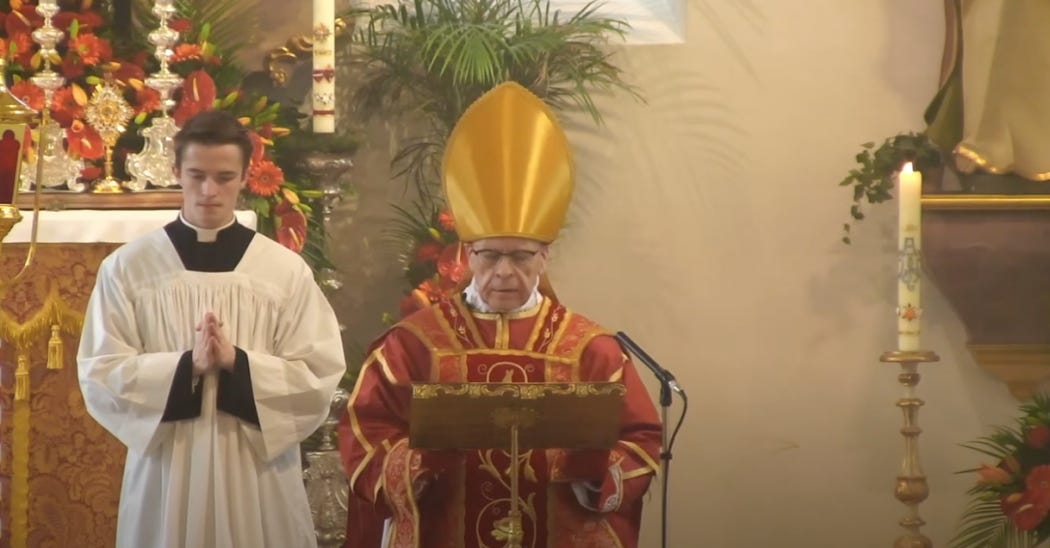
That which follows is an excerpt of a sermon recently given by a Resistance priest, commenting on the SSPX episcopal consecration of four bishops on July 1.
While rejoicing in the consecrations, he notes that, given the recent positions and praxis prevailing within the Society for the last 14 years, the justification adduced by having recourse to the state of necessity is more difficult for the SSPX to sustain than in 1988.
For example, if you don’t doubt the validity of the conciliar sacraments (as +Lefebvre did), what need have you of more bishops, when you can simply avail yourself of the services of conciliar prelates like Huonder, Strickland, and Schneider for ordinations, confirmations, and holy oils?
Of course, the argument overlooks the fact that the same conciliar prelates, were they ordered to abstain from assisting the SSPX, would certainly comply.
Nevertheless, the priest’s observations are interesting in their own right, and therefore placed before you for reflection.
Can these consecrations be equated with those performed by Archbishop Lefebvre?
Not entirely, it seems to us, and for several reasons. For several years now, the SSPX has gradually distanced itself from Archbishop Lefebvre’s position on several important points, such as:
- Doubts regarding the validity of all Novus Ordo sacraments, due to the minister’s intention.
- The distinction between the Catholic Church and the conciliar church.
- The non-acceptance of the new Code of Canon Law, until a legitimate authority—the only one capable of deciding the matter—tells us what to do.
- The impossibility of seeking recognition from the conciliar authorities before a doctrinal agreement is reached.
This difference makes the 2026 consecrations more difficult to defend than those of 1988, since the state of necessity can no longer be invoked in the same way.
Indeed, the state of necessity is based on:
1) The validity of the sacraments, and
2) The intact and integral transmission of the deposit of the Faith.
Validity of the sacraments
Archbishop Lefebvre, as we have seen, relied on the state of necessity to justify his grave act of consecrating without a papal mandate. And this necessity—here is how he presented it: “You know very well, my dearest brothers, that there can be no priests without a bishop. All these seminarians who are here today—if tomorrow the Good Lord calls me back—and that will no doubt be very soon—well, these seminarians, from whom will they receive the sacrament of Holy Orders? From conciliar bishops, whose sacraments are all doubtful. Because we do not know exactly what their intentions are. That is not possible. Now, which bishops have truly preserved the Tradition, who have preserved the sacraments as the Church has administered them for twenty centuries up until the Second Vatican Council? Well, they are Bishop de Castro Mayer and myself. I can’t help it, but that’s the way it is.”
However, since the superiors of the SSPX no longer distinguish between the Catholic Church and the conciliar church, they no longer—or hardly ever—consider the question of intention in the sacraments, contenting themselves with examining the matter, the form, and the minister (and whether the minister properly follows the rubrics). Consequently, they are more and more accepting the Novus Ordo sacraments as valid a priori.
Thus, they have accepted that Bishop Huonder (a bishop dubiously consecrated in the Novus Ordo) consecrate their holy oils, which are necessary for the validity of the sacraments of Confirmation and Extreme Unction (not to mention all the anointings and consecrations made with these oils).
Thus, several priests from the Novus Ordo who join the SSPX are sent to the faithful without having first been ordained conditionally. We have even known of a case where a Novus Ordo priest requested this and was refused: he had to be re-ordained conditionally in secret by Bishop Williamson at Bishop Zendejas’s residence in N. Y.
Another example: the District of England published an article written by Rev. Father Nicholas Mary, CSSR, on the question of whether one must be reconfirmed conditionally when one has received Confirmation in the Novus Ordo. This article concludes in the negative, unless there is a positive doubt: this teaching goes directly against the Council of Trent.
We could cite many more concrete examples, but the limitations of a sermon do not allow us to do so. But in fact, the SSPX of Bishop Fellay and Fr. Pagliarani acts and preaches as if the Novus Ordo sacraments were to be considered valid, unless the contrary can be proven.
But then, they can no longer rely on Archbishop Lefebvre’s argument. It is no longer a matter of saving the sacrament of Holy Orders: for according to their logic, the bishops of the conciliar Church are, a priori, validly consecrated as bishops. One wonders, then, what the state of necessity means to them.
They get around this by saying that the situation is precarious (Fr. Gleize, “New Episcopal Consecrations: An SSPX Theologian Answers Young People” – 05/01/26). But the question then is: Is a precarious situation sufficient to legitimize a consecration without a papal mandate? This act is so grave that an ipso facto excommunication was decreed by the Holy Office on April 9, 1951.
It should be noted that the Fraternity of St. Peter, the Fraternity of Christ the King, and the Institute of the Good Shepherd (to name just a few) find conciliar prelates every year to ordain their priests. Bishop Schneider and Bishop Strickland, who support the SSPX, would likely have agreed to ordain the priests of the SSPX. So, is there really a state of necessity (from their point of view)? The SSPX struggles to establish this. They had denied the state of necessity for the consecrations of Bishop Williamson; they now assert it for themselves, but since they have some difficulty justifying it, they tell the faithful that it is too complicated for them and that they must not doubt the SSPX but trust them! (Sermon by Fr. Gleize at Saint-Nicolas-du-Chardonnay, April 12, 2026). To put it bluntly, one could summarize the situation as follows:
Archbishop Lefebvre performed consecrations in 1988 for the sake of the Church, to ensure the continuity of the priesthood.
The SSPX in 2026, (if we look at it from their perspective), ordained bishops out of convenience, for its own benefit.
Transmission of the Deposit of Faith
But there is also the question of preserving and preaching the Faith. Bishops also have a mission to preach and condemn errors. In this area, the SSPX feels more comfortable invoking the state of necessity. But this brings a somewhat sad smile to one’s face, because for years it has toned down its condemnation of errors in order to establish good relations with the authorities and obtain “gifts” from them, such as jurisdiction over confessions, marriages, or ordinations. This, incidentally, was the advice they had received from the branding firm they consulted: “Emphasize positive communication; criticism is seen as a negative strategy.”
Oh, certainly! Here and there, there have been condemnations of the excesses of conciliar Rome, but without displaying exceptional courage or taking great risks: certain diocesan bishops, and even some cardinals, have publicly condemned these excesses.
Of course, there are still priests in the SSPX who make their voices heard, such as the District Superior for France, Father Peignot, who wrote a beautiful letter defending the honor of Our Lady. And there remain good priests in the SSPX who continue Archbishop Lefebvre’s good fight, but they are few and far between and are often isolated, even persecuted (I know of several cases personally). And these good priests who remain, feel so isolated that they gradually end up toning down their denunciations. This was one of the first things Father Dominique Rousseau wrote when he left the SSPX: he could once again preach against errors without feeling moral pressure. Another priest from the SSPX told me personally that when he compared his sermons as a young priest to those he gives today, he noticed a decline in his fighting spirit. He was known for opposing this desire for reconciliation, and he was so marginalized and sidelined because of it that he eventually left the SSPX. A seminarian from ******** with whom I remain on good terms, told me he was having trouble with his superiors because he shares Archbishop Lefebvre’s views on the Novus Ordo sacraments: today, he does not know if he will be ordained a priest.
Bishop Williamson was expelled; Bishop Tissier de Mallerais was censured (a letter from the Dominicans was banned in the U.S. by Father Rostand because it included Bishop Tissier’s article on the conciliar Church). Priests who oppose the reconciliation are gradually being sidelined and replaced by young priests trained in the new school of thought.
A friend of mine, a priest in the SSPX, told me, “We no longer make bold, sweeping declarations, but we send well-prepared documents to Rome. It’s more effective.” Except that the faithful are no longer being formed or protected, and in Rome, they couldn’t care less about their documents: they’ll just gather dust on the shelves!
Of course, there have been the recent professions of faith by the superior, Father Pagliarani. But a profession of faith is not enough to wipe away with a stroke of a pen everything the superior has allowed to happen and continues to allow to happen—and for which he is accountable before God. Sins of omission are more serious when committed by a superior. Yet it was under Father Pagliarani that we witnessed the “Bishop Huonder” episode, that priests from the Novus Ordo are sent every Sunday to the faithful (in the U.S. and Poland) to administer doubtful sacraments, that priests refused to grant conditional Confirmation to the faithful, that one priest invited his parishioners to attend the Indult Mass at the end of a procession, and that another invited a priest from the Fraternity of St. Peter to replace him during his absence. And these are not baseless accusations on my part; the context of a public sermon calls for a certain degree of discretion, but in private, I can name a specific person behind each of these incidents.
All of this makes their invocation of a state of necessity for the consecrations less tenable than it was in 1988.
As an aside, this priests adds, later in the sermon:
“Archbishop Lefebvre had established the following principle of action: no practical agreement without doctrinal agreement.
In 2012, under the pretext of prudent adaptation to circumstances, the SSPX authorities decided to cast this principle aside. Despite the examples of the affiliated institutes, all of which ended in failure, the SSPX believed it could convert the modernist authorities from within.
Dismissing—sometimes violently—all those who advised them not to deviate from Archbishop Lefebvre’s prudent stance, the SSPX authorities spent 14 years trying to curry favor with the modernists in Rome. And to what end? Fourteen years later, here they are once again falsely excommunicated, and all the few privileges they had managed to obtain have been revoked.
On July 1, 2026, the SSPX proved right all those who, for 14 years, had sought to dissuade them from this dead-end path of reconciliation with modernist Rome. It emerges from this attempt weakened and deeply divided, no longer truly knowing how to justify either their position or their consecrations, and responsible for countless injustices and sufferings inflicted upon good faithful and priests who simply wanted to remain faithful to the teachings of their founder, Archbishop Lefebvre.”
Fr. Pagliarani seems profoundly sad because the heretical usurper of the Sacred Throne of St. Peter has not blessed their actions and has declared them outside the communion of the unholy, man-worshiping, immorality-condoning, and religiously disunited society that he commands.
On the other hand, I am sure many of us feel profoundly sad when we read this sermon because we are reminded once again truly how much the Society has fallen and of all the good things that its liberal leadership has forsaken in these past decades.
It is telling a lot, what saddens someone, isn't it.